
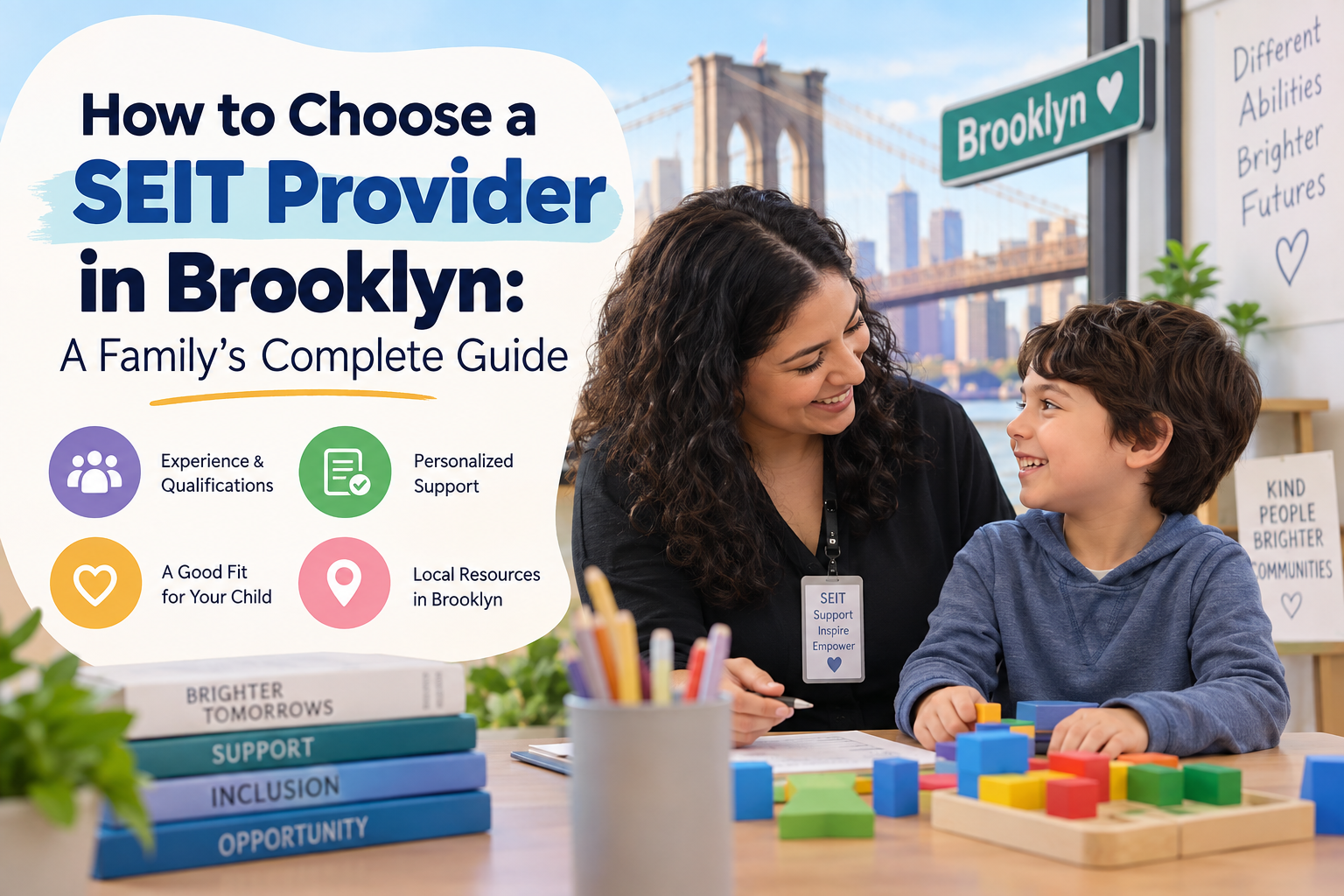
Brooklyn is home to hundreds of thousands of families, dozens of school districts, and one of the most linguistically, culturally, and economically diverse communities in the United States. It’s also home to a large and growing population of preschool-aged children who are eligible for SEIT services through the NYC Department of Education and a marketplace of SEIT providers serving them that can be difficult to navigate without a map.
If you’re a Brooklyn parent who just received your child’s IEP and is now staring at the DOE’s approved provider list wondering where to begin, this guide is for you.
We’ll walk you through everything you need to know: how the provider selection process works, what to look for, what to avoid, how to use local resources and community knowledge, and ultimately how to make a decision you feel confident about.
Because here’s the truth: the SEIT provider you choose matters enormously. It determines the quality of instruction your child receives, the consistency of the relationship between teacher and child, the reliability of communication with your family, and in ways that can be hard to quantify but are very real the trajectory of your child’s development during the most critical years of their life.
Let’s make sure you choose wisely.
Step 1: Understand the Landscape
Before you start comparing providers, it helps to understand what you’re actually comparing.
The NYC Department of Education maintains a list of approved SEIT agencies organizations that have been vetted and authorized to provide SEIT services and bill the DOE directly on behalf of eligible children. When SEIT is written into your child’s IEP, the DOE issues a service authorization, and you choose a provider from this approved list.
You are free to choose any agency on the list that serves your area. The DOE does not rank or endorse specific providers, and no agency is automatically assigned to you. The choice is yours and it’s one you’re entitled to make carefully.
What varies among approved providers:
- Teacher quality and credentials All SEIT teachers must be certified, but experience, specialization, and skill vary enormously
- Teacher consistency Some agencies assign children to consistent, dedicated teachers; others rotate staff more frequently
- Geographic coverage Some agencies specialize in specific Brooklyn neighborhoods; others operate borough-wide or citywide
- Cultural and linguistic competency Brooklyn’s diversity means that language match and cultural familiarity matter for many families
- Communication practices How and how often providers communicate with parents ranges widely
- Supervisory structures How much oversight and support teachers receive from agency supervisors varies
- Program philosophy Approaches to early childhood special education play-based, structured, naturalistic, or clinical differ among providers
Approval from the DOE is a floor, not a ceiling. It tells you that a provider has met baseline administrative and compliance requirements. It tells you nothing about what working with them will actually feel like.
Step 2: Know Your Child’s Needs Before You Start Comparing
The best provider for your family is not simply the “best provider” in some abstract ranking it’s the provider best suited to your specific child’s profile, diagnosis, learning style, and family context.
Before you start making calls or searching for recommendations, get clear on what you’re looking for.
Your child’s developmental profile: What are the primary areas of need listed in your child’s IEP? Communication? Social-emotional development? Sensory processing? Cognitive or pre-academic skills? Adaptive behavior? Some providers specialize in or have deep experience with specific profiles.
Your child’s diagnosis: If your child has autism, Down syndrome, a significant language delay, or another specific diagnosis, look for agencies that have meaningful, demonstrated experience in that area not just one teacher who has worked with a similar child, but organizational depth and a clinical philosophy aligned with current research on that population.
Your family’s language: If your home language is not English or if your child is being raised in a bilingual or multilingual household look specifically for agencies with bilingual SEIT teachers who speak your language. This isn’t a luxury. A SEIT teacher who can communicate with both you and your child in your home language, and who understands the complexity of language development in multilingual children, is a fundamentally more effective partner.
Your preschool or daycare setting: SEIT services are most commonly delivered in the child’s preschool or daycare setting. The right provider is one who has teachers comfortable working in community settings, coordinating with classroom teachers, and integrating into the rhythms of an active preschool classroom not someone who prefers to pull the child out into a separate room.
Your scheduling reality: You have a life. You have other children, work schedules, pickup arrangements, and constraints the CPSE didn’t ask about. The right provider can work within those constraints.
Step 3: Use the DOE Approved List as a Starting Point Not the Whole Story
The DOE’s approved provider list is your official starting point. It confirms which agencies are authorized to provide services in NYC. But it will not tell you:
- Which agencies actually serve your specific Brooklyn neighborhood
- Which agencies have consistent, experienced teachers available right now
- Which agencies have good reputations among the families they serve
- Which agencies respond promptly to family inquiries
To go beyond the list, you’ll need additional sources.
Call the CPSE coordinator. Your district’s CPSE coordinator knows the local provider landscape. While they cannot officially recommend one agency over another, coordinators often have informal context about which agencies are reliably serving families in your area, and which have had issues. Ask: “Which agencies on this list currently serve families in [your neighborhood]? Are there any agencies I should know more about?” A candid coordinator can give you useful orientation.
Ask at your child’s preschool. Preschool directors and teachers in Brooklyn often have direct experience with multiple SEIT providers who have worked in their classrooms. They can tell you which SEIT teachers are known for being skilled, collaborative partners and which are less engaged. This is valuable information that doesn’t appear anywhere on the approved list.
Connect with Brooklyn parent communities. Parent advocacy and support networks are one of the richest sources of honest information about SEIT providers. These include:
- Facebook groups for Brooklyn special needs parents (search “Brooklyn special education parents” or “NYC CPSE parents”)
- Parent support groups affiliated with local disability organizations
- Informal networks of parents at your child’s preschool or daycare
Ask specifically not just “has anyone used X agency?” but “what was your child’s teacher like? Were they consistent? Did the agency communicate well when you had concerns?”
Read reviews carefully but critically. Online reviews for SEIT providers exist but are limited and often lack specificity. When you do find reviews, pay attention to whether they address the things that actually matter: teacher quality, consistency, communication, and progress. Ignore reviews that are clearly written by agency staff.
Step 4: Brooklyn by Neighborhood What to Know
Brooklyn’s neighborhoods vary significantly in terms of which providers are most active, how culturally diverse the options are, and what the local early childhood ecosystem looks like. Here’s a brief orientation:
Bed-Stuy, Crown Heights, Flatbush, and East New York: These neighborhoods have large populations of children receiving CPSE services, and providers with experience in these communities tend to be familiar with community-based daycare settings, cultural diversity, and multilingual families. Bilingual Spanish, Haitian Creole, and Caribbean English-speaking SEIT teachers are particularly valuable in these areas.
Park Slope, Carroll Gardens, and Cobble Hill: These neighborhoods have active parent communities and parent advocacy networks. Families here tend to be well-connected and information-rich. Word of mouth is highly reliable in these communities.
Borough Park, Crown Heights, and Flatbush (Orthodox and Hasidic communities): For families in these communities, gender considerations, religious observance, and schedule requirements around Shabbat and Jewish holidays are important. Providers that understand these needs and have experience serving these communities are not the same as general-purpose providers.
Sunset Park and Bay Ridge: These neighborhoods have significant Spanish-speaking and Arabic-speaking populations, respectively. Providers with bilingual staff who match these communities offer meaningfully better services for children in those families.
Williamsburg, Greenpoint, and Bushwick: Families here often have children in creative, progressive, or community-based preschool settings. SEIT providers who are comfortable working in unconventional classroom environments and coordinating with less traditional preschool staff may be a better fit.
Coney Island, Sheepshead Bay, and Canarsie: These communities sometimes experience provider coverage gaps fewer agencies actively serving the area, and sometimes longer waits for service. Families in these areas may need to cast a wider net and be more proactive in following up after authorization.
Step 5: Interview Multiple Providers
Once you have a shortlist of two to four providers that serve your neighborhood and seem like potential matches for your child’s needs, contact each one and ask to speak with an intake coordinator or program director.
This is an interview. You are assessing them.
Key questions to cover (see our full guide, 20 Questions Every Parent Should Ask Before Choosing a SEIT Provider, for the complete list):
- Teacher qualifications: What certifications does your SEIT teacher hold? What specific experience do they have with children like mine?
- Consistency: Will my child have one consistently assigned teacher? What happens if that teacher goes on leave?
- Communication: How will I receive progress updates? Can I observe sessions? How do I reach someone if I have a concern?
- Data and progress monitoring: How do you track IEP goal progress? What does a progress report look like?
- Coordination: How does the SEIT teacher coordinate with my child’s preschool teacher?
- Timeline: How quickly can services begin after authorization?
- Language: Do you have bilingual teachers in [language]?
Pay attention not just to what agencies say, but to how they say it. Responsiveness, warmth, clarity, and genuine enthusiasm for your questions are good signs. Evasion, pressure to commit, or inability to answer basic questions about teacher qualifications are red flags.
Step 6: Evaluate Fit Beyond Credentials
Credentials matter. Experience matters. But the fit between your family and your provider matters too.
Fit for your child: Young children develop trust-based learning relationships with the adults in their lives. The SEIT teacher who will work with your child for an hour a day, multiple days a week, will become a significant figure in their early life. Think about your child’s temperament, their relationship style, and what kinds of adults they tend to connect with. A gentle, slow-paced teacher may be ideal for an anxious or cautious child. An energetic, high-engagement teacher may be better for a child who needs that kind of activation.
You will not be able to fully assess fit until services begin but you can get a sense of an agency’s style and philosophy through your initial conversations with staff.
Fit for your family culture: Communication style, values around family involvement, and the approach to parental education (teaching you strategies to carry over at home) vary among providers. Some agencies see parents as essential partners in the intervention and actively coach them. Others deliver services more independently. Decide which approach fits your family better and ask specifically about it.
Linguistic and cultural fit: If your family speaks a language other than English at home, a SEIT teacher who speaks that language is not a nice-to-have it’s a meaningful advantage. The teacher can communicate naturally with you, coordinate seamlessly with caregivers who don’t speak English, and understand the linguistic context of your child’s development. Don’t settle for an agency that doesn’t offer this if it matters to your family.
Step 7: Start and Know You Can Change
Many families spend so much energy trying to make the perfect choice that they delay starting services for weeks or even months. During a critical developmental window, that delay has real costs.
Here’s permission to make the best decision you can with the information available, start services, and then evaluate.
After the first month of SEIT services, you should have a clear enough sense of the relationship to know whether things are going well. Ask yourself:
- Is the teacher consistently showing up on time and prepared?
- Does the teacher seem to know my child’s IEP goals and genuinely work toward them during sessions?
- Do I receive regular communication about how sessions are going?
- Is my child warming up to the teacher, or continuing to resist after many sessions?
- Do I have confidence in this teacher’s skill and commitment?
If the answer to most of these questions is yes, you’ve likely made a good match. Continue to ask questions, observe occasionally, and stay engaged.
If the answer to several of these questions is no especially after two to three months of services it is time to consider a change.
How to switch providers
Switching providers is your right. Contact your CPSE coordinator to begin the process. Your child will continue receiving services from the current provider while the transition is arranged. Avoid switching providers so frequently that your child loses continuity, but don’t stay with a provider who isn’t serving your child well out of reluctance to cause disruption.
The disruption of a necessary provider change is almost always less harmful than months of inadequate services during the preschool years.
What to Watch For Once Services Begin
Once you’ve chosen a provider and services have started, stay engaged. The choice you make on day one doesn’t lock in quality forever. Here’s what to watch for over the first months of services:
Consistency: Is the same teacher showing up, session after session? A pattern of last-minute substitutions or session cancellations is a problem worth addressing with the agency directly.
Goal-directedness: Does your child seem to be working toward specific IEP goals during sessions, or do sessions feel unfocused and informal? Ask the teacher what specific goals they worked on in a given session and how.
Communication: Are you receiving meaningful progress updates? Does the teacher communicate proactively when something notable happens in a session, or only when you ask?
Your child’s response: Young children tell you a lot through their behavior. Does your child seem to like the teacher? Do they engage willingly? A child who consistently refuses, melts down, or shows distress around sessions may be signaling something about the relationship or the approach.
Progress: Over the course of months, are you seeing your child make progress on IEP goals? Not every goal will be met every month, but you should see movement. If goals seem completely static after many months, ask for the data and discuss with the CPSE.
Final Thoughts: The Right Match Changes Everything
At Mount Early Bloomers, we’ve had the privilege of watching what happens when a skilled, consistent SEIT teacher meets a child where they are in their home, in their classroom, in their world and spends weeks and months building a relationship of trust, warmth, and playful intentionality.
The progress that unfolds is not always dramatic or sudden. It often comes in small steps: a child who says a new word, who reaches for a toy to share, who climbs the stairs at preschool without help, who laughs and looks up at their teacher with recognition and joy. But those small steps compound. They build the foundation for everything that comes after.
Brooklyn has extraordinary families and an enormous, rich community of children who deserve that experience. Choosing your SEIT provider with care with questions, with community input, with trust in your own instincts is one of the most important things you can do to make sure your child gets it.
If you’re navigating that choice right now and want to learn more about what SEIT services at Mount Early Bloomers look like, we’d love to connect. We serve families across Brooklyn and bring everything we have to every child and family we work with.